


Germany hosts a ministerial welcome for Codex’s “profoundly human” committee

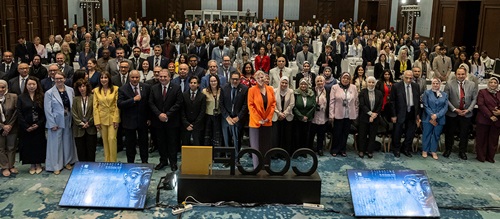
Opening the 45th Session of the Codex Committee on Nutrition and Foods for Special Dietary Uses (CCNFSDU) in Nuremberg, Bavaria, Germany, Chairperson Martine Püster reminded delegates that this is the sixtieth anniversary year of the Committee. “We are very much looking forward to celebrating this with you!” she said. Alois Rainer, German Federal Minister of Agriculture, Food and Regional Identity, delivering his welcome remarks via video message, commented on the unique character of the Committee: “I was told that the meetings of the Codex Committee are known for their family like atmosphere.” He expanded on his comments as he addressed this week’s agenda, continuing: “The agenda of your meeting once again focuses on a target group for which we have a special responsibility, no matter where we are in the world it's about food for infants and young children. This is precisely why your work will be so important in the upcoming days.”
The importance of the Committee’s upcoming considerations of the draft standard for foods for older infants and young children was a focus of remarks from Dr Monika Lahrssen-Wiederholt, Head of the Department Nutrition, Food Security and Consumer Health Protection in the German Federal Ministry of Agriculture, Food and Regional Identity. “The first thousand days from conception to a child's second birthday represents a particularly important period,” she said. “During this time, nutrition has a profound and lasting impact on growth, development and health, and it is therefore all the more important that foods such as baby foods and processed cereal-based foods which are explicitly intended for older infants and young children meet the nutritional requirements of this vulnerable group. This shows just how important the topics are that you are dedicating your time and expertise to.”
Dr Neubauer-Juric (LGL), Vice-President of the Bavarian Health and Food Safety Authority, noted the relevance and importance of Codex work to the food industry globally, and remarked that it is equally relevant locally, to Bavaria. Dr Neubauer-Juric also explained that in her role she oversees issues relating to public health, animal epidemic diseases, animal welfare, occupational safety, product safety “and most importantly today, food safety, and feed safety to some extent.” In her role, she said to delegates, “we are really glad to be able to rely on your important work, which supports us with reliable assessments of individual nutritional needs and as a consequence ensures a reliable supply of nutritions, especially to people with special dietary needs.”
In a video message to the meeting, the Codex Alimentarius Commission Chairperson, Allan Azegele, told delegates, “the work of CCNFSDU occupies a unique and significant place within the Codex system.” He, too, referenced the strategic plan, making the remark that the agenda for the week reflects many of Codex’s strategic priorities. “Discussions on nutrient reference values, foods for older infants and young children, methods of analysis, food additive provisions, and emerging issues will require thoughtful consideration and constructive engagement,” he counselled. He ended with a message close to his heart, by restating that “food is connected to culture, identity, tradition and the knowledge passed from one generation to another,” and asking delegates to think about attending the fiftieth session of the Codex Alimentarius Commission in traditional attire to reflect this observation.
Sarah Cahill, Codex Secretary, took the opportunity of her remarks to note the evolving remit of CCNFSDU and urged delegates to think now on the future of the committee, addressing an issue that marks much of Codex work “This Committee needs leaders,” she said. “We need more Members to step forward to lead working groups, in order for CCNFSDU to remain resilient and be able to address the issues we all agree are important.” Cognizant of the need to encourage a broad spectrum of Members to step forward, she addressed “our experienced delegates: you can help others step forward. Through mentoring and sharing your experience, you will be making a key contribution broadening the leadership of this Committee.”
FAO and WHO representatives, Fatima Hachem and Luz de Regil respectively, spoke on the fundamental importance of nutrition to FAO’s work on agrifood systems transformation and on WHO’s work to promote access to nutritious and safe foods and to protect public health. “Of course, the committee’s work is highly technical, but its ultimate purpose is profoundly human: to contribute to foods and diets that support health and nutrition including for some of the most nutritionally vulnerable groups,” said Hachem, while De Regil made the point that “Codex standards can help promote access to nutritious and safe foods, protect public health, foster fair practices in food trade, and support the transition towards more sustainable food systems.”
Read more
Related content

CCMMP11 brings global standard for pasteurized liquid camel milk a step closer
The report of the 11th Session of the Codex Committee on Milk and Milk Products (CCMMP) has been adopted in a virtual session following a month of work by correspondence to consider the draft standard...
Contaminants committee advances codes of practice for final adoption and new work proposals for approval by the Codex Alimentarius Commission
The 19th Session of the Codex Committee on Contaminants in Foods (CCCF) concluded in Cairo, Egypt, advancing three codes of practice for final adoption and agreeing on new work proposals, including guidelines...

Contaminants committee meets in Cairo as Egypt co-hosts
The 19th Session of the Codex Committee on Contaminants in Foods (CCCF) has opened in Cairo, Egypt with opening remarks from the Egyptian co-hosts, the Codex Alimentarius Commission Chairperson, Codex...

Meet the new chairperson of the Codex contaminants committee
At CCCF19, Dr Sally Hoffer will hand over the CCCF chairmanship to Dr Susanne Sütterlin. We sat down with Susanne to discuss her views, expectations and plans for leading the Committee.This interview is...

CCFICS28 concludes after “a very big but a very productive week”
The 28th Session of the Codex Committee on Import and Export Inspection and Certification Systems (CCFICS) has concluded after what the Committee Chairperson, Tom Black, called “a very big but a very productive...

A committee of shared purpose: Sally Hoffer on the evolution of CCCF
Dr Sally Hoffer has chaired the Codex Committee on Contaminants in Food since 2021. CCCF19 will be her last as Chairperson, as she hands over to her successor, Dr Susanne Sutterlin. We spoke with Dr Hoffer...

Interconnectedness is a key factor in inspection and certification work, as Committee meets for 28th Session
The 28th Session of the Codex Committee on Food Import and Export Inspection and Certification Systems (CCFICS) opened in a hybrid format in Perth, Australia, on 12 October, with opening remarks from the...

Have you met the Fishmonger?
Codex standards are science-based and developed with input from Codex Members and Observers who bring their experience and expertise to the standard development process. Implementation of Codex standards...

Discussions by correspondence on the proposed standard for pasteurized camel milk get under way
The newly reactivated Codex Committee on Milk and Milk Products (CCMMP) has started its 11th session, with a single agenda item, with the aim of developing a standard for pasteurized liquid camel milk....