


CCFICS28 concludes after “a very big but a very productive week”
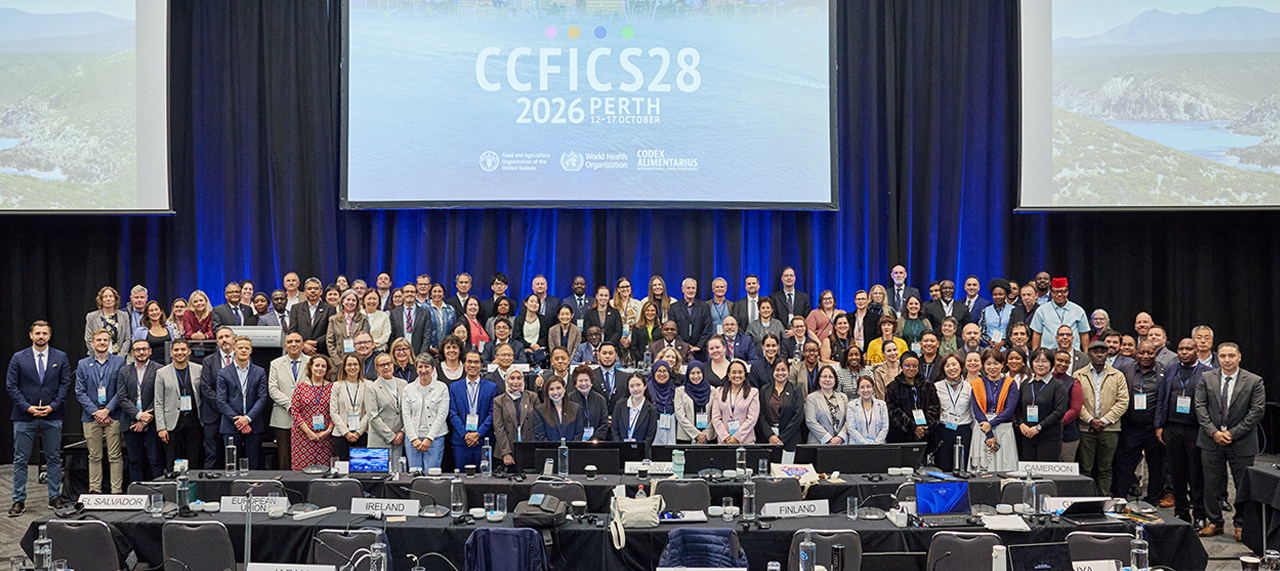
The 28th Session of the Codex Committee on Import and Export Inspection and Certification Systems (CCFICS) has concluded after what the Committee Chairperson, Tom Black, called “a very big but a very productive week”. The Chairperson thanked everyone involved and commented to delegates on “the spirit with which you have worked, the approach that you have taken to find solutions to difficult issues, and your approach to work expeditiously on matters that are clearly important to both this Committee but also competent authorities, industry and consumers right around the world.”
CCFICS28 faced a substantial agenda which required an additional day of plenary discussions. As was amply indicated in the opening remarks to this Session, the topics are complex, interconnected, touch on the work of other Codex committees, and underpin the network of connections that make international trade in food possible.
The guidelines on the prevention and control of food fraud, which were adopted at Step 5 by CAC49 were completed this week and forwarded for final adoption. The outstanding issues on this topic were considered by a physical working group (PWG) just prior to the plenary session, which facilitated the discussions. In agreeing to forward this text, it was noted that these new guidelines will support or supplement existing Codex texts by providing additional guidance specific to food fraud that can be considered within national food control systems (NFCS).
The work to consolidate Codex guidelines related to equivalence was the subject of a New Zealand-chaired intersessional working group (IWG), which took place in Oslo, Norway in March 2026, and which significantly aided the progress of plenary discussions on this topic. CCFICS forwarded the draft principles and guidelines for the recognition of equivalence of sanitary measures, technical requirements, national food control systems (NFCS) or a part of a NFCS to CAC for adoption at Step 5/8. In tandem, the Committee recommends to CAC the revocation of the related texts that are now consolidated in these principles: Guidelines for the development of equivalence agreements regarding food imports and export inspection and certification systems (CXG 34-1999), Guidelines on the judgement of equivalence of sanitary measures associated with food inspection and certification systems (CXG 53-2003), and Guidelines on recognition and maintenance of equivalence of national food control systems (NFCS) (CXG 101-2023).
The draft principles on digitalization of national food control systems were also forwarded to CAC for adoption at Step 5/8. These principles are of particular significance to FAO as they will form the basis for the Organization’s work in developing countries. FAO invited any Members interested in supporting implementation of these principles to partner with FAO.
Two sets of revisions were agreed. Successful discussions on revisions of the Principles for traceability / product tracing as a tool within a food inspection and certification system (CXG 60-2006) saw the work forwarded to CAC, at Step 5. There are issues outstanding, which are anticipated to conclude at the next CCFICS session. Also forwarded to CAC for adoption at Step 5/8 was the draft revision of the Principles and guidelines for the exchange of information between importing and exporting countries to support the trade in food (CXG 89-2016) to provide an annex on principles and guidelines to harmonize the use design, implementation and update of establishment listing. The finalization of this work was significantly supported by progress made at the Norway-chaired IWG that also took place in Oslo in March 2026.
Two draft documents that were considered were returned to their respective EWGs for further elaboration. These include draft guidance on appeals mechanism in the context of rejection of imported food, intended to be an annex to the Guidelines for food import control systems (CXG 47-2003), with appropriate cross-references to Guidelines for the exchange of information between countries on rejections of imported foods (CXG 25-1997) to avoid duplication of existing provisions. The second document to be returned to its EWG was the draft guidance on the standardization of sanitary requirements, which help improve both paper-based and electronic certification systems by standardizing the representation of attestations in official certificates in a clearer and more consistent manner. This work will become an annex to the Guidelines for design, production, issuance, and use of generic official certificates (CXG 38-2001).
The Committee added three issues to the standing agenda item to review and update “Appendix A” - list of emerging global issues.
A discussion paper on artificial intelligence in food import and export inspection and certification systems: application of CCFICS principles to AI-supported regulatory processes, saw the establishment of an EWG to prepare an updated discussion paper and project document on principles and guidelines for the use of artificial intelligence and advanced analytical tools in NFCS.
Read more
Related content

Germany hosts a ministerial welcome for Codex’s “profoundly human” committee
Opening the 45th Session of the Codex Committee on Nutrition and Foods for Special Dietary Uses (CCNFSDU) in Nuremberg, Bavaria, Germany, Chairperson Martine Püster reminded delegates that this is the...

CCMMP11 brings global standard for pasteurized liquid camel milk a step closer
The report of the 11th Session of the Codex Committee on Milk and Milk Products (CCMMP) has been adopted in a virtual session following a month of work by correspondence to consider the draft standard...
Contaminants committee advances codes of practice for final adoption and new work proposals for approval by the Codex Alimentarius Commission
The 19th Session of the Codex Committee on Contaminants in Foods (CCCF) concluded in Cairo, Egypt, advancing three codes of practice for final adoption and agreeing on new work proposals, including guidelines...

Contaminants committee meets in Cairo as Egypt co-hosts
The 19th Session of the Codex Committee on Contaminants in Foods (CCCF) has opened in Cairo, Egypt with opening remarks from the Egyptian co-hosts, the Codex Alimentarius Commission Chairperson, Codex...

Digital tools can strengthen food control systems, but regulatory decisions should remain subject to human oversight
At an event showcasing tools and initiatives to digitalize food control systems during the 28th Session of the Codex Committee on Food Import and Export Inspection and Certification Systems (CCFICS28)...

Meet the new chairperson of the Codex contaminants committee
At CCCF19, Dr Sally Hoffer will hand over the CCCF chairmanship to Dr Susanne Sütterlin. We sat down with Susanne to discuss her views, expectations and plans for leading the Committee.This interview is...

A committee of shared purpose: Sally Hoffer on the evolution of CCCF
Dr Sally Hoffer has chaired the Codex Committee on Contaminants in Food since 2021. CCCF19 will be her last as Chairperson, as she hands over to her successor, Dr Susanne Sutterlin. We spoke with Dr Hoffer...

Interconnectedness is a key factor in inspection and certification work, as Committee meets for 28th Session
The 28th Session of the Codex Committee on Food Import and Export Inspection and Certification Systems (CCFICS) opened in a hybrid format in Perth, Australia, on 12 October, with opening remarks from the...

Have you met the Fishmonger?
Codex standards are science-based and developed with input from Codex Members and Observers who bring their experience and expertise to the standard development process. Implementation of Codex standards...